Articles · Updated
For most of us, gold means rings, chains and pieces that carry memories. Fewer people realise that the same metal sits inside their phone, in dental surgeries and even on spacecraft. What makes gold so useful comes down to a handful of rare properties – and those properties are also why old gold can be reused again and again.

Five properties that make gold special
Each property on the left explains where gold ends up on the right.
Small amounts, essential jobs
In technology and medicine, materials have to be completely reliable – a tiny fault in a connector or an implant can have real consequences. That’s where gold earns its place. Each device uses only a tiny amount, but added together it’s significant: according to the World Gold Council, technology used around 320 tonnes of gold worldwide in 2025.
Why gold can be reused endlessly
The same properties that make gold useful also make it ideal for recycling. Melting and refining don’t change gold at all, so recycled gold is just as good as newly mined gold.
An unused ring in a drawer
Its gold is exactly the same as the day it was made.
Melted and refined
The other metals in the alloy are separated out and the gold is purified.
A new life
New jewellery, electronics, dental work or investment bars – with no loss in quality.
Every gram reused is a gram that doesn’t need to be mined. We look at the bigger picture in the circular economy of gold, and you’ll find more surprising facts in 10 facts about gold.
What about the gold you own?

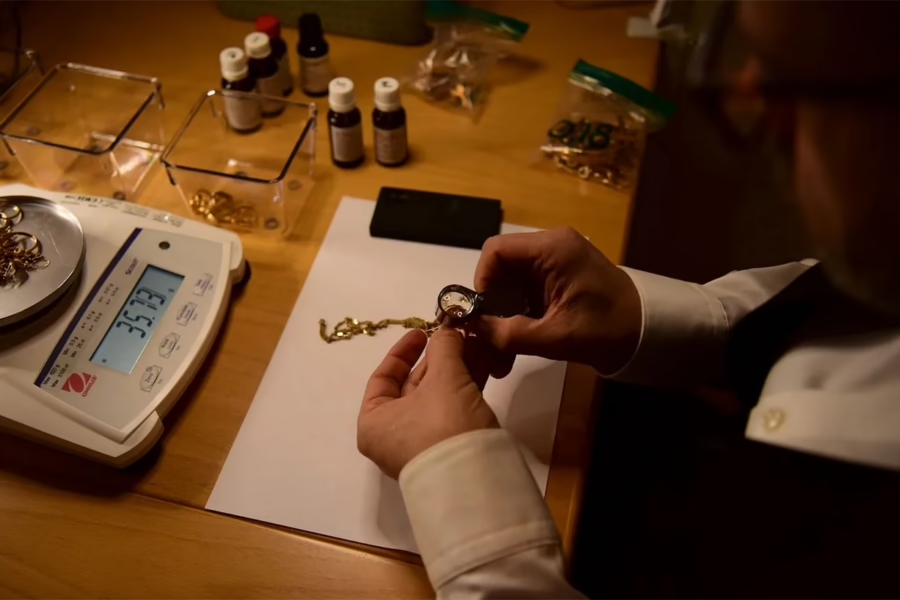
The size or condition of a piece doesn’t tell you how much gold it contains – that depends on its weight and purity. Some gold-coloured items contain very little gold, others more than you’d expect. The only way to know is to have them tested and weighed.
At a free, private Gold Arthur valuation at a local stop, everything is evaluated in front of you and the expert explains the result. There is no obligation to sell. Read what happens during a gold valuation.
Frequently asked questions
Why is gold used in electronics?
Because it conducts electricity well and never tarnishes, so connections stay reliable for many years – even in very small components.
How much gold is in a mobile phone?
Only a tiny amount, spread across many contacts. It matters when millions of phones are made, but a single phone contains far less gold than a typical ring.
Is recycled gold as good as new gold?
Yes. Gold doesn’t lose any of its properties when it’s melted and refined, so recycled gold is identical in quality to newly mined gold.
Why is pure gold not used for everyday jewellery?
Pure gold is very soft and scratches or bends easily. Mixing it with other metals – as in 9ct or 18ct gold – makes jewellery strong enough for daily wear.
Sources
- World Gold Council: Gold Demand Trends – Full Year 2025 (2026)
Checked 2 October 2026.