Guides · Updated
Found some gold you no longer wear and wondering whether to sell it? Understanding a few basics – how the gold price works, how much gold your jewellery actually contains and how an offer is put together – makes the whole process clearer and your decision easier. This guide covers everything you need to know before selling gold in the UK.
1. How the gold price works
When the news reports that gold has gone up or down, it’s talking about the spot price: the live wholesale price of pure gold on the international market. It changes throughout the day with currencies, interest rates and investor demand, so the value of the same ring can be noticeably different from one month to the next.
Quoted per troy ounce
A troy ounce is about 31.1 g – heavier than a kitchen ounce.
Often in US dollars
So the pound’s exchange rate also affects the UK price.
Jewellery is valued in grams
And on its pure gold content, not its total weight.
Nobody can predict where the price will go next. That’s why the most useful thing you can know is not “the right time” but what your own items actually contain.
2. How much gold your jewellery really contains
Gold jewellery is always an alloy – gold mixed with metals such as silver or copper to make it strong enough to wear. So a 20 g chain doesn’t contain 20 g of gold. The carat tells you the share that is pure gold:
Weight in grams
×
Purity (e.g. 0.375 for 9ct)
=
Grams of pure gold
×
Purity (e.g. 0.375 for 9ct)
=
Grams of pure gold
20 g chain · 9ct
7.5 g
of pure gold
20 g chain · 14ct
11.7 g
of pure gold
20 g chain · 18ct
15.0 g
of pure gold
Same weight, three carats: the 18ct chain contains twice as much gold as the 9ct one.
In the UK, 9ct (375) is the most common standard, so many pieces contain less gold than people expect – while older 18ct and 22ct pieces often contain more. You’ll find every standard explained in what do different carats mean.
3. How an offer is worked out
An offer for gold jewellery is based on three things: the weight, the purity and the gold price at the time of the valuation. It’s always below the spot price you see in the news, and it helps to understand why.
The spot price is for pure gold, traded in large quantities between professionals. Jewellery gold first has to be melted, separated from the other metals and refined before it can be used again – and that involves assaying, refining, transport and insurance. A buyer’s offer reflects those steps. What matters is that you understand how your offer relates to the market price, and a clear valuation will explain that to you.

A clear valuation tells you
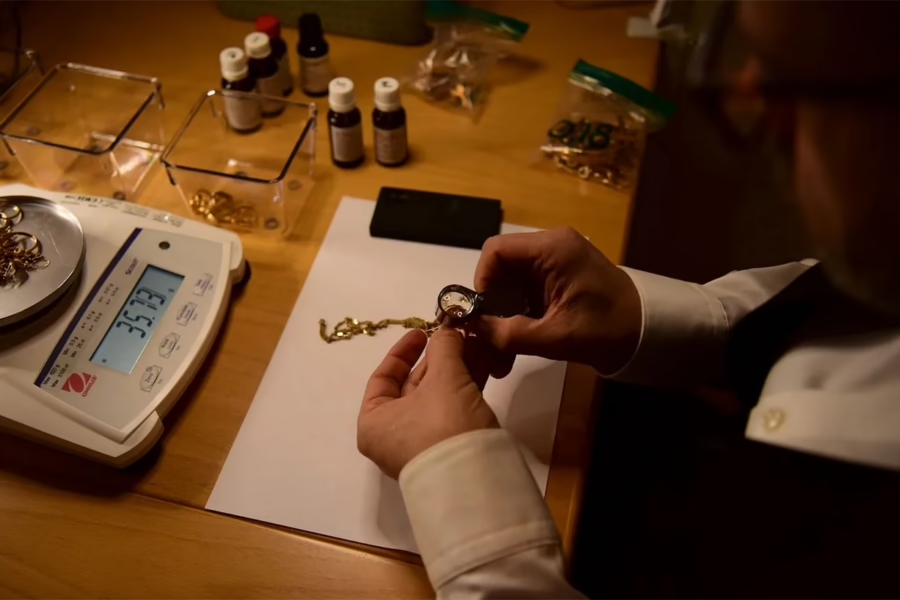
✓ the weight of your items, read from the scale
✓ the purity found from the hallmark or a test
✓ how the offer relates to the current gold price
✓ when and how you’d be paid
4. What you can sell
Broken and damaged gold
A snapped chain, a bent ring or an earring without its pair contains just as much gold as an intact piece of the same weight and purity. Condition, scratches and engravings don’t change the gold content.
Any colour of gold
Yellow, white and rose gold of the same carat contain the same amount of gold – the colour simply comes from the other metals in the mix.
Just one item
You don’t need a large amount. You’re welcome to bring a single ring or a whole box – every item is checked individually, and you can sell some pieces and keep others.
Items you’re not sure about
Not every gold-coloured item turns out to be gold – some are plated, and some aren’t gold at all. Bring them anyway: you’ll leave knowing what you have. If you’d like to check a few things first, see how to tell if gold is real at home.
5. UK rules that protect you
The UK has some of the oldest consumer protections for precious metals in the world. Two are especially useful to know when you sell:
Approved scales
Scales used to buy or sell precious metals must be approved for trade use under the Weights and Measures Act 1985 – only class I or class II instruments are allowed.
The Dealer’s Notice
Anyone dealing in precious metals must display the official Hallmarking Act 1973 notice explaining UK hallmarks, in the form approved by the British Hallmarking Council.
6. Do you pay tax when you sell gold?
For most people selling a few pieces of personal jewellery, tax isn’t an issue – but the rules depend on what you sell and how much you make. UK legal-tender coins such as Sovereigns are generally exempt from Capital Gains Tax, while gold bars and larger sales can be treated differently. We summarise the main rules in investment gold vs jewellery.
General information only, not tax advice. If you’re selling a large collection, check GOV.UK or speak to a tax adviser.
7. How to prepare
Gather everything in one place – including broken pieces, odd earrings, old watches and coins.
Set aside what you want to keep. Decide on sentimental pieces before your appointment, not during it.
Don’t clean or polish – heavy cleaning can wear down hallmarks.
Think about stones. Stones aren’t included in a gold valuation, so let the expert know if you’d like to keep them.
Ask about collector value for branded watches or rare coins before deciding.
Have your bank details handy if you think you might sell.
8. Selling with Gold Arthur

Everything is weighed and tested in front of you, and the expert explains each step so you know exactly what the offer is made of. There is no obligation to sell, and if you’d rather think it over, you take everything home. If you do sell, you receive a receipt by SMS and e-mail and are paid by bank transfer no later than the fifth banking day – never in cash.
For the valuation itself step by step, read what happens during a gold valuation, and for a quick overview of the whole journey, the easy way to sell gold.
Frequently asked questions
How is the price of my gold calculated?
From the weight of the gold, its purity and the gold price at the time of the valuation. The expert explains how your offer relates to the current market price.
Why isn’t the offer the same as the gold price in the news?
The news price is for pure gold on the wholesale market. Jewellery is an alloy that has to be refined before it can be reused, and that process has costs.
Can I sell gold without a hallmark?
Yes. If an item has no clear mark, its purity is checked with a test during the valuation.
Do I need to bring anything with me?
Just your items. If you think you might sell, have your bank details to hand, as payment is made by bank transfer.
When will I be paid if I sell?
Payment is made by bank transfer no later than the fifth banking day. Gold Arthur never pays in cash.
Can I take some time to decide?
Of course. A valuation never obliges you to sell. You can take everything home and come back to us another time.
Sources
- GOV.UK: Hallmarking: how businesses can comply with the law
- Trading Standards Business Companion: Hallmarking
Checked 2 October 2026.