Articles · Updated
What do the tiny numbers on your jewellery mean? Why does everyone talk about carats – and what is the spot price? If you’re looking into your gold and silver before a valuation, the jargon can get in the way. This A–Z explains the terms you’re most likely to come across in the UK, in plain English.
Purity and carats
- Alloy
- A mix of metals. Pure gold and silver are too soft for everyday jewellery, so they’re combined with metals such as copper, silver, zinc or palladium to make them stronger – and to change the colour.
- Carat (ct)
- The purity of gold on a scale of 24. 24ct is pure gold; 18ct means 18 of 24 parts are gold (75%); 9ct means 9 of 24 parts (37.5%). In the UK it’s written “ct”; American sources use “karat” and “K”. The full list is in what do different carats mean.
- Carat (diamonds)
- The same word, but a different measure: for diamonds and gemstones, a carat is a unit of weight (0.2 g), not purity.
- Fineness
- Purity expressed in parts per thousand – the “millesimal” system. 375 means 375 parts in 1,000 are gold. This is the number you’ll find stamped on UK jewellery.
- Sterling silver
- Silver that is 92.5% pure, marked 925 – the most common silver standard for jewellery, cutlery and household items.
- Britannia silver
- A higher UK silver standard of 95.8%, marked 958. It’s softer than sterling and seen mainly on finer pieces. More on silver in silver is more valuable than you think.
Hallmarks and other marks
- Full hallmark
- Three compulsory marks struck together by a UK assay office: a sponsor’s mark, a fineness mark and an assay office mark. In the UK, gold items of 1 g or more must be hallmarked to be sold as gold.
- Assay office
- An independent body that tests precious metal and applies the hallmark. The UK has four: London (leopard’s head), Birmingham (anchor), Sheffield (rose) and Edinburgh (castle).
- Sponsor’s mark
- Initials showing who made the piece or sent it for hallmarking. Often called the maker’s mark.
- Date letter
- An optional letter showing the year the piece was hallmarked. Like other extra marks, it tells the item’s story but doesn’t add to the metal’s value.
For a step-by-step guide to reading these marks on your own items – and what it means if they’re missing – see how to tell if gold is real at home.
Price terms
- Spot price
- The live wholesale market price of pure gold or silver, used as the reference price around the world. It changes throughout the day with the economy, currencies and investor demand.
- Troy ounce
- The unit precious metals are priced in: about 31.1 grams. It’s heavier than an everyday ounce (about 28.3 g), so don’t mix the two up.
- Scrap value
- The value of the metal itself, as if the piece were melted down – based on weight, purity and the spot price, regardless of design, brand or age. Sometimes called melt value.
From spot price to your offer
Spot price – pure gold, wholesale
Scrap value – the gold actually in your piece
Your offer – after refining and costs
Before gold can be reused it has to be separated, refined and transported, so any buyer’s offer is below the spot price. A good valuation explains how the figure relates to the market price. See what happens during a gold valuation.
Plating and surfaces
- Rhodium plating
- A thin, bright coating of rhodium, most often on white gold. It wears with time, which is why old white gold can look yellowish. It changes the look, not the gold content.
- Gold-plated
- A very thin layer of gold over a base metal. May be marked GP, GEP (gold electroplated) or HGE – or not marked at all.
- Gold-filled & rolled gold
- A thicker layer of gold bonded to a base metal, often marked GF, RGP or with a fraction such as 1/20. It lasts longer than plating, but the gold content is still small.
- Vermeil
- Gold-plated sterling silver. It looks like gold, but it’s hallmarked as silver (925).
Mark converter: UK standards at a glance
These are the fineness marks recognised for UK hallmarking. If you find something else – such as 333 or 830 – the piece was probably made or marked abroad.
Knowing the terms makes selling easier

In the end, all these terms describe the same two things: how much precious metal an item contains, and how its value is worked out. Once you know them, it’s much easier to follow a valuation and understand an offer.
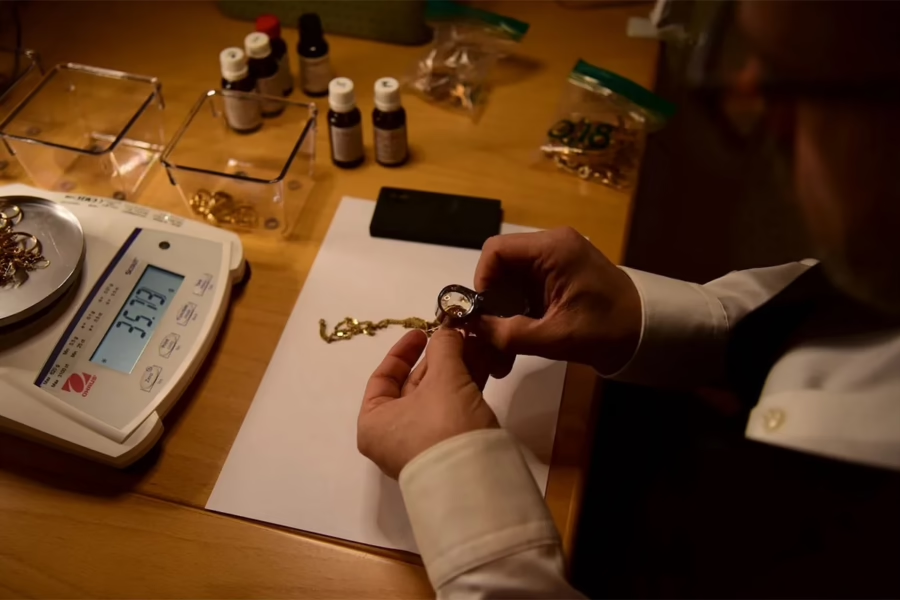
Well-loved pieces often have worn or missing marks. At a free, private Gold Arthur valuation at a local stop, an expert checks the purity and weighs your items in front of you, then explains the result in plain words. You can bring as few or as many items as you like, and there is no obligation to sell.
Frequently asked questions
What does 375 mean on jewellery?
It’s the fineness mark for 9ct gold: 37.5% of the metal is pure gold. 9ct is the most common gold standard in UK jewellery.
What’s the difference between carat and karat?
In British English, “carat” (ct) is used both for gold purity and for gemstone weight. American English uses “karat” (K) for gold purity and “carat” only for gemstones.
Is scrap value the same as what I’ll be offered?
Not exactly. Scrap value is the metal’s value at the spot price. An offer is lower, because the gold still has to be refined and transported before it can be reused.
My jewellery says 333 or 830 – is that real?
Quite possibly. These aren’t UK hallmarking standards, but they’re used elsewhere – 333 is an 8ct gold standard found on some European pieces, and 830 silver is common on older Scandinavian items. A test confirms the metal.
Does gold-plated jewellery have any value?
It contains real gold, but usually so little that it adds very little value. An expert can tell you whether there’s enough gold in an item to value.